Sunday, July 15, 2018

Nothing Left To Lose, Part Two


It's a sunny, beautiful Sunday, and even though it's almost brutally hot, I'm working outside, waiting for the coffee to finish brewing. Last night, I opened a tab to "new post" here, so that I would stop forgetting to write this article. It's been a while in coming, as I was thwarted in publishing this album at my store by a dead computer in need of a new charger, and now it's been a few days - like a week - since I got it up there. I've also been struggling with a lack of motivation. There was quite a while after With Love, Catatonia during which I wasn't even writing new music; normally, I'd have songs lined up even while promoting for a new EP or album. The songs have been slow in coming these days. I am, however, starting to diligently make it a practice that I'll work on music every day, no matter what aspect. Even writing this article counts (posting on social media, however, does not). Originally it was a goal to have a new full-length album ready for publication by July 30th, the anniversary of Elemental and Dialectical Observations. Now I've pushed it back to the more likely and looser time period of sometime-this-winter.

This album was also a little slow in coming. To be frank I'm not that impressed with my new label, Rehegoo, so far. I'm sticking with it because I want the full experience (and if there's a chance of licensing my music to a third party, then it might be worth it) but I've yet to see much in the way of promotion for Nothing Left To Lose, Part One and I had to get on their ass to get Part Two published. However, they have put both "The Seventh Swan" and "Wrong Pocket Kinda Day" - both from this half of the album, somewhat ironically - on compilation albums that, from what I can see, has totally boosted the awareness of those songs, and in turn, my music.

So, to get you up to speed: Nothing Left To Lose has been a long time gestating, from my very first EP. The track list has been tested in some form or other, mostly on my Patreon patrons, over the past three years. I finally drew a line in the sand as to what could be included after the EP Elemental, focusing mainly on the essentials from my first five albums, and I decided it needed to be limited to twenty tracks - a difficult feat, as I had produced somewhere over a hundred songs. But a demo was locked into place for a good while, and I was waiting for some occasion to publish it. I'd hoped to put it out on physical media, like CDs and vinyl. I'm still a ways off from my being able to fund that independently. But hey, I'm no longer entirely independent! I decided signing on with a label was just the catalyst needed for publication.

Without planning to, it seems I put most of the "hits" (on regular radio rotation) on the first half. There's still some songs, on here, that are being played by one station or another. "Wrong Pocket Kinda Day," "The Seventh Swan," and "Matriculating" still pop up every now and then on indie radio. And "The Cloud Walkers" and "Fistfuls of Whimsy" had their time in the sun. I think of the former three as being more radio-friendly ambient pop, while the latter two are more esoteric and epic in nature. So there's half of this second part of the album that has seen mass exposure - nothing to sneer at. Oh, I almost forgot about "The Nocturnal Dervish." It was my most popular song for quite a while, and it also saw some airplay on Darkwave Radio, the first station to play my music.

I guess "Dervish" makes a good segue to briefly go over each song on the track list. "Dervish" started life as a dark piano ballad called "Dusk Devils." After a stepping-stone remix called the "Whirlwind Mix" (now an extreme rarity) I made a more successful "Nocturnal Dervish" mix, which soared to relative popularity on Soundcloud, and was one of my first to be put into regular radio rotation. I'm not sure which was first anymore - "Slowly Scooting Closer" and "The Last Waltz" also made their way onto Darkwave Radio at about the same time. I'm getting ahead of myself, though. The "Dervish" mix greatly overshadowed its source material, so much that I began to regard it as its own separate entity. That's when its name was shortened from "Dusk Devils (Nocturnal Dervish Mix)" to simply "The Nocturnal Dervish."

Quite some time had passed that when I listened to it, some flaws began to glare at me; mostly the convoluted multi-layered drum tracks. Overlaying multiple drum machines has become a regular technique of mine, but this was one of the first times I employed it, if not the first. But it was sounding so overly busy to me that I decided to simplify it, specifically for the Nothing Left To Lose demo. The Instrumentality Project, on which it was later included, was partly an excuse to make it public. I think I may have gone overboard in writing some additional instrumentation. I thought it very subtle, but I think I should have perhaps stuck with simplifying the beats. Maybe someday I'll simplify the "Simplified" mix.

Track 02 ("Matriculating") on this collection was one of those early, unintentional happy accidents in which a song with more pop sensibilities found itself tweaked by metal aspects. It doesn't fall completely into an urgent rush of industrial-metal like "Wrong Pocket Kinda Day," but like "The Seventh Swan" it found that metal-ish electric guitars were a natural progression. This has, like the overlaid drum tracks, started to become a regular writing style of mine. But back then, it was always a fun surprise to me when it would happen, seemingly of its own accord.

Since I just kind of covered tracks 04 ("The Seventh Swan") and 05 ("Wrong Pocket Kinda Day") I'll just comment that "Day" was named for when things take a wrong turn during a so-far perfect day, while "Swan" named itself, and I imagine its namesake to be some kind of faery tale character.

Now, track 03 ("A Different Story") was a completely foreign writing experience, a style that I haven't really reproduced since. It's origin was an attempt to create a rhythm section entirely out of tweaked synths. Some bass and drums were added as a natural step later, but what I had accomplished was something that sort of sounds like "R2-D2 being tortured," as my mom put it. Then, curiously, I wrote an almost neoclassical interplay of piano and acoustic guitar over it. I guess I sort of repeated the experiment, and ended up with a similar piano-and-acoustic-guitar overlay, with Dialectical Observations' "Man Seeking Cocoon," but they're really not the same. "Story" was something really different for me, and that's where it got its name, as I was then relating my music to stories in my head. That's something I kind of miss - associating songs with the faery tales in my mind. I've been hoping to do more short story writing to get back into that groove.

Moving on to track 06 ("Cold Sunlight"): I'd been attempting to write something jazzy that got shelved for some time, then began to turn into psychedelic rock when I picked it up again. It just so happened that I was listening to what I had thus far, outside and smoking on a sunny winter's day. I began to croon about what I was seeing and experiencing, then immediately began to write it down as lyrics. There were some rhymes and lines that were thrown out, but I began to incorporate a new stanza with every next few measures of music I wrote. Similar to Jaded's "Mr. Douter," I found myself writing lyrics and instrumentation simultaneously, which seems to be the method of writing songs with vocals-and-verse that works best for me. This was my most successful attempt at such a song, and it even earned some attention from an indie radio host and reviewer. So, it's notable and I feel an essential tune from my repertoire.

Seven is a magical number to me, and it just so happens that I considered track 07, "The Cloud Walkers," to be my finest achievement for quite a while. So yeah, it had to be a part of this collection. It was informed by writing styles that I was just starting to explore, and it contained some methods that have since become regularly used in my songwriting. I wanted a dark piano ballad with a sort of industrial-metal quality, and I ended up writing something kind of epic. It was my longest song up to that point, yet it didn't feel drawn out anywhere. There's some of that interplay of piano and acoustic guitar, and it's one of my first experiments with the inclusion of electric guitars. I felt I had really outdone myself, and I was afraid that I would never surpass it. Now I feel as though I have, with songwriting techniques that have evolved and become more polished. But it all owes quite a lot to "The Cloud Walkers."

I may have published it prematurely in my desire to share it, though. I kept on toying with it for a little while afterward, and found myself switching around some arrangements, adding a little bit, and subtly changing the ending. A more settled version was published on a no-longer-available EP called Selenophilia. When that EP was pulled from shelves, it wasn't available for a while. It was essential it get back out there. I republished it on my fifth album, Cognitive Behavioral Therapy, and now it's integral to representing my discography.

Track 08 ("The Tranquil Isles") was originally inspired by the more ambient works of my favorite band, Tool - "Right in Two," in particular. That's where the rhythmic synths came from; the rest was formed around a wandering acoustic guitar melody. I found myself thinking of the Sea of Tranquility when writing this song, that it might make a good setting in the adventures of my mascot, the Snail. I tried the Latin name, but that didn't quite sit well with me. Instead, I found a trail of islands forming in my imagination similar to the settings of the adventures in C.S. Lewis' Voyage of the Dawn Treader. So that's where the Snail found Itself instead.

The lullaby of "Isles" has been the perfect ending for many mixes of my music that I came up with, as well as others in general, but I found myself juggling three songs that I felt would be a perfect way to end Nothing Left To Lose. "Microcosms" is short, sweet, and simple. "Fistfuls of Whimsy" is epic, and its latter half is one of the most perfect pieces of music I've written. I tried several combinations of these songs for the ending, kind of hoping that it would decompress and fade with "Isles." But the natural progression had other ideas. Instead, I went from a lullaby to a neoclassical ballad to a post-rock epic. Maybe it works out best this way. Whatever, it's what ended up sticking in the demo, and that's how it was ultimately published.

Rehegoo has published Nothing Left To Lose, Part Two at all the usual suspects, including Spotify, Google Play, Apple Music/iTunes, Amazon, Napster, and TIDAL. Once I've finished my Facebook and Google Plus Jukebox posts for each of its songs, I'll post a playlist at my YouTube channel. Since I most likely have all the songs posted at my Soundcloud, I may round them up into playlists there as well. Of course, the best and most direct way to support me and my art is through the link in the embedded player, or you can pledge at my Patreon and get Nothing Left To Lose as a downloadable reward, along with many others.

That's about it for now. I'm hoping it will cool off enough this evening that I'll brave working on mastering a full draft of my latest tune. That will put me one step closer to completing a new album and releasing new music to y'all. I sense you shivering with anticipation. Until then, may your inner snails remain resilient and determined.


Saturday, June 2, 2018

Nothing Left To Lose, Part One


I finally went ahead and did it. It felt like time. My new contract with Rehegoo Music seemed to be the needed catalyst to finally bring it into the world. Nothing Left To Lose is an album I've talked about making since I started self-publishing music. The decision to finally take the big step of making my art available for public scrutiny was because, well, I had nothing left to lose. I was at the ultimate low-point of my life: recovering from an extended hospital stay that left me largely immobile, I kept my mind occupied by composing music, beginning with an app for my phone. That first EP was my Progress Report to the world of my recovery, and I decided it would be the first step toward an album called Nothing Left To Lose - also a reference to the Janis Joplin song "Me and Bobby McGee."

It never seemed the right time, the right special occasion, to finally assemble and publish the album, though I test-ran compilations of different names on myself and Patreon patrons over the years. They were all, invariable, "best of" compilations, up to that point in time. It seemed that I was just waiting for something. I've often said, when promoting the demo that's been a Patreon reward for quite a while now, that I was hoping Nothing Left To Lose would be my first album distributed on physical mediums - CDs and/or vinyl. To do that, I'd need to raise a lot of money independently, and if there's one thing I've learned is that I needed help. Artists such as Amanda Palmer, who have already made quite a name for themselves, will advise that getting into bed with a label is one of the worst things an artist can do. That can be perfectly valid counsel, so I've been skeptical and careful, and what I've found in Rehegoo Music is a label that will allow me to do exactly what I'm doing, the way I want, with a voice in how they handle whatever I pass on to them, on a non-exclusive basis. Really, it's an experiment for me - clearly, this is something I've never done before. But I think I've found the best possible entity, and way, to give this whole label thing a try. And I'm going for the full experience.

And how outstanding an ego boost is it that they scouted me out and approached me? Total bragging rights reserved there. Hopefully it doesn't bite me in the ass.

I've been letting Rehegoo take the lead on this one and treading carefully to try not to breach the contract, so I've let them publish this one first. As such, it's already available at Spotify, Google Play, Apple Music/iTunes, Amazon, Napster, and TIDAL.

A little about how I chose the songs and why: Track 01 was really a toss up between "Introducing... (Alternate III)" and "Jade's Theme (Introduction)," but I decided that "Alternate III" was more representative of the song's original intention, and "Introduction" was better suited on The Instrumentality Project, which it had been written for. "Alternate III" was actually written with Nothing Left To Lose in mind, while Jaded Winters was an excuse to make it public. Besides, I kind of like "Alternate III" better. Now I already have an idea for another version, that would be a cross between the two - well, I guess a simplified version of "Introduction." But that's for another time, and not until I have an excuse to publish it.

"Fervens" is just one of my favorites. It doesn't seem to have ever been really popular, but I consider it to be one of my best works. Originally inspired by Thom Yorke, it took the principle of "Simplify," that simplicity can create beautiful songs, and I wandered over it with some meandering acoustic guitar until it really took on life and built in intensity. Because it was a slow build, I took the latin for "simmer" or "to boil" for the title...to be a little pretentious, if I'm honest. I don't actually know latin. The Internet helped with that one.

"Simplify" was a hit, relatively. It was my most popular song at Soundcloud for quite a while, and it was also in regular rotation on a few radio stations. I believe it still is. It was an exercise in letting go of the mindset that the more complex a tune is, the better, and it was a lesson that simplicity can create beautiful art.

"Darkest Dreams" is the instrumental of "Sublime Like Swine," published because I couldn't decide if I liked it better with or without vocals. I decided that they both have their merits as separate entities, therefore deserved separate titles. The instrumental happens to be more popular, which is why it was chosen for Nothing Left To Lose. This is my "nu-metal" song, inspired by Placebo's "Post Blue" and sounding a bit as if it's from the Korn era of hard rock. It proved to be a bit of a hit, also earning airplay.

Another "hit", and one of my first to be put into regular radio rotation, "Slowly Scooting Closer" was a success that I henceforth tried to replicate, and ended up informing my songwriting thereafter. My music took on a more "darkwave" identity for quite a while. With Dialectical Observations, I've drifted away from that sound, but I proved with Neoclassism that I haven't shaken it off, and I probably never will completely. Therefore, it's one of the most representative songs of my music.

"Safe in Cars" is another personal favorite that has never been very popular, except, oddly, with classical music lovers on Google Plus. This was my "driving song," not just fun to drive to, but also a reminder that you can become too relaxed in your speedy metal boxes, with the occasional metallic burst to remind you to "Wake the fuck up!" and remain alert, because your safety is an illusion. Either you or someone else can cause an accident at any time; though, if anything, the road system is odd proof at how well-organized human beings can be when they agree on common sets of rules.

"Passage Through the Veil" was an attempt to replicate my once-upon-a-time "magnum opus" "The Cloud Walkers," trying for another post-industrial neoclassical-ish epic. I wasn't sure I'd succeeded, but it's subsequent popularity, especially after being highlighted in the Starlight Music Chronicles Artist of the Month competition, indicates that I have. It's been the most popular song at my YouTube channel, as well as on other streaming platforms at one point in time or another. This is my "wormhole" song, trying to capture the sense of falling down the rabbit hole, or lifting the veil between one reality and another, a sort of graceful vertigo, if that makes any kind of sense.

"The Last Waltz" is the most popular version of a quite popular song, "Giger's Lullaby," which now numbers eleven different versions, most known as "Waltz with Lilith" or "Waltz for Giger." As the most popular version, it was the logical choice for Nothing Left To Lose. "Last" was also one of my first to be accepted into radio rotation, on Darkwave Radio, another song wrapping me up in a much-explored gothic identity. The "Waltz"s were inspired by the biomechanical nightmares of surrealist H.R. Giger, whose one of my favorite artists of all time. I love any movie featuring his xenomorph, and the psychosexual evocations of his work are deliciously unsettling. To make a "lullaby" to wrap oneself in images that I've grown to find oddly comforting was the goal. Okay, it ended up kind of cheesy, but I think it's fun and delightfully gothic. And this is a version that hopefully inspires some kinetic energy, being a sort of post-industrial trip-hop remix.

"Winter's Salve" is my signature piano ballad, one of my earliest compositions, and a song that I continue to revisit. I decided to try my hand at writing something with a more classical style, which was also a test to see how much of my five years of piano lessons, from twenty years ago, had stuck. It began as "Winter's Discontent," as I went into my first winter of recovery from my hospitalization, anticipating a very dark period of my life. Instead, my attempts at solo composition kept me productive and buoyed my spirits. It became "Winter's Salve," and this is one of the newest versions, despite it having no subtitle to indicate as much. The original "Winter's Salve" was only ever a bonus track on a limited edition, and I'm kind of glad it's such a rarity, because it's grown to be much more solid over the past three years. I've decided to pretend this is the original. Like "Introducing (Alternate III)," it's a newer version than the prior-to-Dialectical Observations time period of the rest of Nothing Left To Lose, but I made an exception because it's derived from an old song.

And "Revolutions" has, like "Simplify," reigned as my most popular song on Soundcloud and other streaming platforms. Probably my most danceable tune, it was a test-run of an "intuitive" AI drummer that came with an upgrade of my composing program. Well, the drummer wasn't intuitive enough, though it did have some beats that would take me hours to program in note-by-note, so I took what it came up with and sliced and spliced it so that the emphases and swells were in the right places, also layering it over other drum tracks, as I went along.

So that wraps up Part One. Like I said, I've been letting Rehegoo take the lead on this one, so no word yet on when Part Two will arrive. I've just sent them an email nagging them about it, though. It took a few weeks after they received the tracks for this one to get published, so that may be the norm, though I sent the tracks for Part Two at the same time. Maybe they just feel that spacing them apart more is a better marketing strategy? I have no idea what goes on in their collective brains. They have multiple departments needing to communicate with each other, and I am by no means their only artist. However, "The Seventh Swan" is on Part Two, and has already appeared on one of their compilations. So I'm hoping Part Two is still a thing... Even if it isn't, I'll be going ahead and publishing it at my own store.

Here's to the future of Nothing Left To Lose! Until then, may your inner snails remain resilient and determined.


Monday, May 21, 2018

With Love, Catatonia


It's been two months between posts, something I'd really like to not let happen. I wanted to do a review for the new Shakey Graves album, Can't Wake Up, when it was released - I even listened to it several times in a row (not that that was much of a chore) in preparation - but I never seemed to have the time or energy. I've been having problems with being low-energy lately, but I've also been really focused on the new EP. Really, I wrote five songs in two months, and each is one that I've been really proud of and excited to share with people. The third month, I gave myself time to tweak it, experiment with it, and edit it. With Dialectical Observations, and since then, I've come to the realization that I can put a really quality product out there if I give myself around that amount of time to play around. And after listening to With Love, Catatonia obsessively before its release, I've come to the conclusion that there's absolutely nothing I want to change now. Maybe by the time of my next full-length album... I'd rather not say "never," and who knows what the next album will bring. Anyway, I've decided that a full-length album with the best-fitting material from Neoclassism and With Love, Catatonia is next. So far, it's shaping up to have a similar feel to Dialectical Observations, but I'd rather not go into it with a goal in mind for its sound. Such as with Neoclassism, I'd like to let the songs decide for themselves.

Speaking of Neoclassism - isn't it odd that it's follow-up would have a more "neoclassical" sound? After Dialectical, I thought I'd be continuing down a more ambient/neoclassical path, but no, Neoclassism decided it would be in a more post-industrial vein, sounding similar to my fourth album, Revolutions. Then With Love, Catatonia seemed to pick up where Dialectical left off, with something more ambient-pop and focused on string arrangements. Okay, the strings thing isn't evident in the first song, "Cataphany," which is more straightforward trip-hop, guided by a repeated succession of piano notes. Putting in cello was more of an afterthought, though it started with the bowed bass. I really wanted a deep bass sound, and I succeeded with something that throbs, and has some interesting riffs. And the beats...I love the beats. I think I pulled off something wonderfully "post-industrial pop." It puts me in an optimistic mood with an easy-to-get-into groove.

I'd been reading Gregory Maguire's After Alice (which is kind of flat for a Gregory Maguire book, by the way) and it wraps up with the musings of a fictionalized Charles Darwin:

"I was musing on the notion of cataphany...from the Greek 'cata,' meaning down, and 'phantazein,' to make visible. Also the root of 'fantasy,' don't you know.  'Cataphany': an insight, a revelation of underness... Let me put it more scientifically. If separate species develop skills that help them survive, and if those attributes are favored which best benefit the individual and its native population, to what possible end might we supposed has arisen...that particular capacity of the human being known as the imagination?"

This little speech resonated with me more than the rest of the book did, and you may have noticed that I have a thing for made-up words. I jotted down the word and decided it had to be the title of a song. And so, the music itself, when coupled with the title, means to me the optimism that can be achieved through imagination. It was a sort of revelation in itself, musically achieved. I was really eager to share this song, but I exercised restraint. In fact, I held off on sharing so much as a preview of any of these songs, except for "Puzzlebox" to Patreon patrons, which was actually the first song written for this EP. By virtue of its experimentalism, it seemed more fitting for a finale than an opener. I used "Cataphany" to try and set a tone for the overall EP instead.

The optimism continues in "Revel," which has the fastest pace, and continues a bit with the throbbing bass, in portions of the song, at least. This song was composed on guitar rather than piano, something I've never really done before; it eschews piano entirely, making it a rarity. Actually, it began with the opening strings, which were in part inspired by Dialectical Observations' "Less Sinister Cousins." They were intended to set an epic tone, but instead became relegated to the background by additional strings and guitar, and mostly the beats. Oh, the beats. Trying something different - instead of layering drum machines and kits, I switch between three. This creates different "styles." "Hip-Hop," "House," and "Classic." In a 3/4 time signature rather than a 4/4, it creates an off-kilter feel to each. But somehow it's continually danceable, with each flowing effortlessly into the other, rather than creating a dissonance. These, and the cello, are at the core of "Revel," raveling it together into a cohesive whole. And it's the beats that provided the song name. It reminded me of the "hip-hop" beats uncharacteristically used in the faerie revels taking place in an after-hours mall foodcourt in the book Widdershins, by Charles de Lint - you may have noticed that de Lint influences me quite a bit. Anyway, with the juxtaposition of the beats, flute, and string quartet, I thought this might be used in a revel at an urban faerie court.

I electronically transitioned (though this song was written prior) into piano overtaken by more strings in "Power Time Gravity Love." It began with a cello melody composed over piano arpeggios, then I removed the piano when it felt jarring next to the flowing of the cello and viola. I tried without really succeeding to mimic the feel of the beats used in "Cataphany." The light pulsing tapped out doesn't quite tonally match, and more incongruous industrial clanging and hissing is used for a more epic effect. There's a lot of industrial and electronic elements here, but I faded them into the background. In the end, this song is about the flowing grace of a streaming cello melody that is then reexamined every which way. The initial piano chords are echoed by acoustic guitar for a lighter tone. I was head-over-heels about that cello melody, and had a lot of fun trying it a few different ways, and then on different strings. At last, to wrap it up, it seemed fitting to pluck the melody at its essence on an echoing electric guitar. 

The title for this song comes from the musing of a character in the novel Cloud Atlas (I love both the book and the movie) that the most influential forces in our lives are invisible. This seemed nothing short of a revelation to me, and I had to jot it down. Don't ask me why I attached it to this song. These things often decide for themselves and seem to be out of my hands.


"Misplaced Romanticism" is the oldest song on the EP. It was considered for Neoclassism, in fact, but it never felt quite right, and instead became a bonus track on the Patreon-exclusive Artist's Edition. It's gone through a few iterations since, with my tinkering trying to perfect it, and never quite succeeding. I became a bit obsessed with trying to get it right, and get it onto With Love, Catatonia. The piano never changed - that's where its essence lies, especially in that opening, tinkling melody. Some of the strings seemed solid enough to be set in stone. It was mostly the cello that felt wrong. It kept causing a bit of discord, and I couldn't isolate what it was. I copied song files and tried different things with it so many times that I've lost track. I'd seem to have it...and still, it would sound wrong. I think sometimes I overcomplicated it. In the end, this might be the closest to the original I've recorded in a long time, with just two-or-three notes changed. This is different from the Neoclassism version. I feel, after listening to it several times, that this is the right version. Maybe I'm just sick of changing it, but I'm pretty sure I finally got it. It sounds pretty solid to me. This was the second-to-last song finished (I tried some experiments with "Power Time Gravity Love" up to the last couple of days) and the first written. Some songs just take longer than others. I think the quickest to be written was actually "Puzzlebox."

For as complicated as "Puzzlebox" is, it's amazing how quickly it came out, and that it never changed. Initially, I just wanted to sustain a strings chord, with a staccato burst at the end. Who knew where it would go wrong there? Then I started tapping a synth along with it, but realized they were in different time signatures. And the following piano was in yet a third time signature. Could I really synchronize all three in an interlocking, harmonizing structure? Well, the first step would be to not write anything overly complex. The concept of the song was complex enough. Deep breath...let's keep things simple, but compelling. Now the beats were compelling, and I think by themselves could hold a listener's attention. There's no real melody here. Everything is just pieces fitting together, sometimes in absentia, but mostly adding one layer on top of another. Each layer was fun for me to work with, and I was mesmerized by how, after 64 (I think) bars, it all came back together. I wanted to do this twice, and keep things interesting, so a couple of odd synths and a two-note flute came into play. Then, after 128 bars (again, I'm recollecting from a few months ago) it all came together again, and I closed it with a single chord, which added an acoustic guitar that had been nowhere else in the song. Afterward, I kept describing this as a "puzzle box" of a song, though it's original name was "Bells for Him," in a nod to Tori Amos. Then, I shrugged and thought, if I'm going to describe it this way, why not just name it "Puzzlebox"?

This is a relatively "minimalist" album, in that most of the songs don't contain the sixteen-or-more layers of instrumentation that I normally use. It felt a little more graceful and less cacophonous that way. There's nothing truly epic here, more relaxing and at times even light-hearted, than anything else. That's why I've come to describe it as "a gentle start to your morning, a soothing lullaby, or a deep breath in between." After the relentless pace of Neoclassism, I seem to have explored the complete opposite end of my post-industrial spectrum.

With Love, Catatonia is available on (links will be highlighted as they become available) Spotify, YouTube, Google Play, Apple Music, iTunes, Amazon, TIDAL, Napster, and something called iHeartRadio that I've never heard of before. Oh well, it's nice to be on new things! Oh, and I haven't even begun to tell you about the label I've signed on with, or my desperate need for Patreon patrons (I'm at zero right now) and the (I think) soon availability of Nothing Left To Lose through Rehegoo Music! Well, more on that later, probably when Nothing Left To Lose is actually released.

Until then, may your inner snails remain resilient and determined.


Wednesday, March 21, 2018

An Arcane Design:

The Arcane Insignia, and its Debut Album, A Flawed Design


I'll start off by saying, I've been waiting for this album since 2015. I first became acquainted with The Arcane Insignia's frontman/composer/guitarist/vocalist on Twitter, of all places. We found a mutual appreciation for each other's music - he called "Slowly Scooting Closer" a "beast" of a song, and I fell in love with an EP (more of a demo) from 2013, which contained five songs: "Car(di)nail & (Sub)liminal," "Chapter 9: Trail of Extinguished Suns," "Panopticon," "The Violence Within," and "Vicarious Virtues." These songs had me chomping at the bit, eager for more; I was repeatedly told, "It's coming soon," referring to a full-length album that I anticipated would be heavenly.

The result, released March 16th, 2018, was more of a single composition than an album: it's arrangements of acoustic seven-string guitar, strings, and acoustic percussion are equally neoclassical and progressive rock, with the vocals more of an accompanying instrument, the lyrics a prose of  metaphorical and spiritual poetry. The guitar is often used for percussive riffs, as often at it's plucked melodiously, with even a little metal-inspired flavor.

"Kingdom of Wolves" starts off the album as a lengthy prelude to seven additional "chapters" (that's the best description I can come up with) and after three listens, I already know I need a booklet of lyrics (incidentally, you can find the lyrics for each song at the band's Bandcamp page), to read along with the music. It's easier to hear the vocals as an additional instrument, and the lyrics are seldom repeating or rhyming, making the possibility of memorizing seem an intimidating feat. But that's part of their appeal: this is thoughtful stream-of-consciousness prose rather than your standard fair, adding to the sense that this is a musical epic. The lyrics are more of a companion to Alejandro's voice, guitar, and percussion; Noah Heau's cello; and Tina Chang-Chien's viola and backup vocals.

"Architect of a Flawed Design" continues the story, with a light neoclassical intro segueing into more percussive guitar and violently sawed strings. Metaphors of questions and statements is highlighted - unexpectedly and thrillingly - by a choir contributed to by Martha Stella Calle (Alejandro's mother, and a tremendous source of strength and support in his life), Allie Jessing, and Jamel Lee.

It is stated that "Chapter 9: Trail of Extinguished Suns" is the "song that started it all." It was one of the first songs that I became acquainted with, almost immediately finding tits way into two playlists in my iTunes: "Acoustic/Electric/Eclectic" and "Another Soundtrack for Another Life." And that's what it became: essential to the soundtrack of my life. Rereleased as an advance single for the album, I was excited to experience a new version that didn't disappoint. The vocals became overlapping and harmonizing, including backing accompaniment. It was a new experience with which I felt extremely satisfied, and increased my anticipation of the album, which I was again reassured was "coming soon" - I was hesitant, but so wanted to believe.

Another song, "Car(di)nal (Sub)liminal," was also appropriately used an advanced single, and again it was one with which I was already familiar, equally as important in my life as "Trail of Extinguished Suns." It offered up new delights, again in the form of overlapping and harmonizing vocals. New strings arrangements gave the song a more orchestral feel, yet it stands on its own as a progressive rock tune.

"Obelisk Pt 1: Fallen Shell" is the melancholy prelude to an epic of self-discovery, part one being what I interpret as a tale of a changed man who does not recognize his transformation as necessarily a good thing. However, part two, "Liquid Skies," changes perspective of this transformation, with adversity recognized as an ally to self-discovery; of the changed man being a step in the journey toward a being perfect in his imperfections, the metaphorical "obelisk." It speaks of a very Buddhist view of the self, which is a form of spirituality that Alejandro has embraced. A comparison of this song that comes to mind is Tool's two-part epic "Wings for Marie," though whereas "Wings" is more psychedelic ambient rock, this is more neoclassical progressive rock. Still, I think "Obelisk" is a kindred spirit.

Lastly (before a hidden bonus track you have to download the album to hear) is "Gemini Cycle," a song graceful is its entirety, guitar and strings playing off each other in classical fashion until the vocals join the fray,. Alejandro is yet again joined by Martha Stella Calle, Allie Jessing, and Jamel Lee, in elevating choral arrangements.  The song's instrumental interludes are many and welcome, bringing it beyond the level of typical progressive rock.  I have to say that every song aside from "Trail of Extinguished Suns" and "Car(di)nal (Sub)liminal" have a certain novelty for me for being new, and I'd be hard-pressed to choose a favorite, but this song's neoclassical grace, combined with the sublime choir, strikes a chord within me: my favorite qualities of eccentric rock are finally in a single song!

I had to confess to Alejandro that I was disappointed in the absence of "Vicarious Virtues," one of my favorite songs; but I was promised that it would be on the sophomore album, which I'm already eagerly anticipating. Hopefully I won't have to wait for three years this time, but if I do, it will undoubtedly be worth it. I know from past experience that The Arcane Insignia's composer won't do things half-assed, especially where his art is concerned. I think that all his fans will agree with me that we appreciate it, and that we've been rewarded for our patience and support.


A Flawed Instrumental


Okay, I was going to go with this as a post-script, but upon listening to it, it's clear it deserves a whole lot more.

Available at the band's Bandcamp page is an instrumental version of A Flawed Design, which I was hesitant about - I couldn't imagine the album working without the instrument of Alejandro Saldarriaga Calle's vocals and his metaphorical and spiritual prose - but I had to try it out. From the beginning of "Kingdom of Wolves" onward, I was blown away, all over again.

I'll start by noting that "Kingdom of Wolves" - a seventeen-minute epic - is now broken down to five parts. The con palabras (with words) version is a little intimidating, as you have to commit yourself to hearing it as a whole, or why bother? I personally find it impossible to pause or skip once it's begun. It's a terrific opening track, but as a five-part instrumental epic, it gives you options. I still have to see it through, as well as it works as a neoclassical instrumental. And there's no other label for it. "Neoclassical" is definitely the way to go. It easily compares to the works of Lorenzo Masotto, my favorite composer of this genre. But differing from many neoclassical compositions, which often have electronic components, this is boldly acoustic.

The guitar, either melodically plucked or rapidly strummed, is usually the source of rhythm here, though staccato bursts from the strings sometimes take their turn. Percussion, in this case, is often provided unconventionally by the guitar/viola/cello trio, while actual acoustic percussion instruments - a tambourine here, some toms and bass-kicking, a cymbal there  - are used for accent and emphasis, as carefully placed as any of the other players at work here. The primary "rock" component is the guitar's metal influences, but it is also a major part of what makes this such a unique work, as a neoclassical composition. And it is almost fluidly a single composition. Parts are broken down for your convenience; though, "Obelisk" is now melded into a single track. Hearing it as a unified piece is almost a whole new experience. Hell, hearing all of this instrumentally is a whole new experience. By turns, it's so melodic and frenetic, and always impressive.

It is worth mentioning that the end of "Obelisk" has been transformed for its instrumental incarnation, both gentler and more fierce.

Like "Kingdom of Wolves," "Gemini Cycle" has been broken down into five components. I would characterize them as more "bite size," but each chunk is its own unique little movement. As pensive and dramatic as this song is as a whole, it's fun - yes, fun - to see it from this perspective. Each track gives me a little thrill that makes me a bit giddy.

A Flawed Design [Instrumental] brings to mind the difference between Tori Amos' Night of Hunters and its sin palabras counterpart. Each works beautifully in its own way. You would think that the absence of vocal melodies and lyrical poetry would detract from the piece, yet it just provides a different - and insightful - perspective. Here, A Flawed Design is transformed into a neoclassical piece of complex, undulating beauty, different from its prog-rock incarnation in a significant and important, vitally valid way.

 I definitely recommend it. After listening to the con palabras album four-or-five times (I confess, I lost track, as I listened to each song multiple times while writing the above article to be thoroughly informed) I found myself enraptured by the instrumental. It will transport you to a different place, in a very good way.

Thursday, February 22, 2018

Welcome to Anniversary 2018!

Jaded Winters and Fleeting Fractals


This has been an incredibly busy month, as I've been cramming in more than maybe I should have leading up to the third anniversary of my debut EP, Progress Report. 

Progress Report was just that: an update on what I'd been up to and how I was healing following an intense ten-day hospital stay, during which I was violently ill. After my hospitalization I was largely immobile, as the gradual development of neuropathy suddenly hit me full-force, and I could hardly stand because of the pain, and had a very difficult time maintaining my balance. I made my way around the house largely by repelling myself off of walls; stairs were about impossible to manage without crawling; and I used a walker outside of the house. You see, my liver nearly failed, and the damage was spread throughout my body. I ended up staying mostly on the couch and massaging my affected brain with word games on my iPad. Stephen King's Dark Tower series helped keep boredom at bay, perhaps saving my life as I entered a period of severe depression - something I'm already susceptible to.

My discharge from the hospital was on February 18th, 2014, and it was during the following winter that I began to dabble at composing. Music has always been a very large part of my life. I took five years of piano music when I was very young, and I followed that with show choir through middle school and high school. I picked up a guitar and taught myself to play while I was fronting alternative and metal bands as a vocalist. As a soloist, I performed a cappella at open mics. Then I got into a long-term relationship and began focusing on "real" jobs, which lasted six years before a volatile breakup during which I lost everything and had to move to Missouri from Portland, Oregon to try and pick up the pieces of myself and my life. All together, I had about a ten-year hiatus from music.

So I put my years of piano music - and trying my hand at every instrument I picked up - to use on a computer program, and on an iPad app with "simulated" instruments (meaning there's some fret work, strumming, and bowing involved on stringed instruments, apart from the keyboards) and  I composed some instrumentals. One of those earliest was primarily a test to see if those piano lessons had stuck, trying my hand at a more classical-style piece. That song was called "Winter's Discontent," as I anticipated a particularly dark and depressing winter, with my mobility so limited. However, as music became my main focus through this composition work, that winter was not only bearable but somewhat enjoyable, and that song was renamed "Winter's Salve," not completed until after I released Progress Report.

I decided to self-publish some of this work, partly in defiance of every artist's initial fear of making themselves vulnerable by offering up their creation for public scrutiny. Many talented artists I have known have sold themselves short and never pursued that path because of that fear. However, I decided to share this work, even if I didn't plan on selling it, instead offering it up for free, if anyone wanted to download it. I had seven songs ready in February 2015, and decided this "progress report" should be published on the one-year anniversary of my hospital discharge. Instead, in honor of the Dark Tower books that were helping in keeping me sane, I released it on the 19th, a number that figures into that series quite a bit.

The EP almost began with a song called "The Trip Begins," which fortunately has never been heard by anyone else. Being dissatisfied with that song, I instead set to composing a sort of introductory piano ditty, which I completed overnight, and thus "Introducing..." was born. After a couple more cracks at that song, it wound up opening a couple more of those "non-commercial," up-for-grabs EPs. When I actually got confident enough to distribute my work on a wider scale, it opened my first "real" album, Instrumentality, and then a version with beats - "No Introduction Needed" - kicked off my second album, Occultation.

Since then, that melody has been reused a few times, being renamed "Jade's Theme" after a fictional alter ego of mine who is the protagonist of many stories in my head. It's a melody that doesn't seem to be going anywhere anytime soon, and neither is "Winter's Salve."

After a couple of remixes of "Winter's Salve," I decided to try my hand at a minimalist mix closer to the original, bringing to life a version that had been developing in my head to rival the song's definitive version for over two years, the "Alternate Spin." I first shared the result as a bonus track on the Extended Artist's Edition of the album Dialectical Observations, and a desire to make it available to the public at large brought about the idea for Jaded Winters. This also seemed like a good way to bring "Introducing... (Alternate II)" and "Winter's Salve (Alternate Spin)" back into circulation, after their disappearance from my discography, when I decided to pull Instrumentality from stores and streaming platforms.

The concept of Jaded Winters gave me the excuse to try out an all-strings version of "Jade's Theme" that had been matriculating in the back of my mind. This came to fruition as "Jade's Theme (Strung Out)," and then I offered it, and "Winter's Salve (Dialectical)," to the public in a prototype of Winters over the 2017 end-of-year holidays. I knew an "official" version was in the cards for early 2018, and it was a random inspiration to publish it as a Valentine's gift. As it got closer to this release date, I gave another listen to the amateurish "Introducing... (Alternate II)" and "Wnter's Salve (Alternate Spin)." I decided to remove them, and instead made "Winter's Salve (Dialectical)" the definitive version of that song, with a simplified title. I gave "Introducing..." another crack, returning to its original instrumentation, and I recorded "Introducing... (Alternate III)." I then recorded a new mix of "Winter's Salve" with some cool new beats and a couple of synths from a prior, overly-complex remix.  This gave birth to "Winter's Salve (Siren's Call)." This all evened out to the desired number of four tracks.

Backtracking to shortly before Valentine's Day...

I had shared a recording of "Signor Fancypants" on one of my "Jukebox" posts on social media, that wasn't publicly available: how it was on the album Dialectical Observations, but without the interrupted ending that segued abruptly into the introduction for "Less Sinister Cousins." A desire to make this almost single-worthy version widely available also gave me the excuse I hadn't realized I was waiting for to replace the single version of "Fleeting Fractals" with its superiorly mixed Dialectical Observations album version. So it was that a new Fleeting Fractals single came into being with the addition of "Signor Fancypants."

Now, I never did a release article on this blog for either Jaded Winters or Fleeting Fractals, because I knew that I'd be wrapping all of February's activities into one. I never made readers aware of the free-on-Valentine's gift, so to make up for that I'm offering exclusive links here for free downloads:


and


Jaded Winters is also available at Spotify, YouTube Music, Google Play, Apple Music, Amazon, and TIDAL.

Fleeting Fractals is also available at Spotify, YouTube Music, Google Play, Apple Music, Amazon, and TIDAL.

Neoclassism and Distilled


"Neoclassism" was a title I'd known I'd apply to a song or album for some time. I decided that it would be the title of my follow-up to Dialectical Observations, indicative of the neoclassical direction I seemed to be heading in. However, after I record their initial inspirations, the songs tend to decide which direction they'll take. Sometimes it seems like they're out of my hands until I begin  to engineer their final sound.

"Why Can't We Have Nice Things?" and "Surviving Is Killing Me" were first available as two of the bonus tracks on the Patreon-exclusive Dialectical Observations Extended Artist's Edition. "Nice Things" was continuing down that more neoclassical path, with some heavily electronic, industrial-style beats, similar to "Less Sinister Cousins."

Written in a flurry of anxiety that lasted for three days straight, "Killing Me" was a return to previously explored industrial-metal styles, with a title inspired by Fear The Walking Dead - Alicia informs her mother that "just surviving is killing me," or something to that effect.

"Symbolism" and "Reciprocal" were both jump-started by riffs from previous songs, that I'd been wanting to explore further. The piano riff that begins and then peppers "Symbolism" is from both "Overdrive" and "Passage Through The Veil" on the album Revolutions, which I've wanted to continue as a repeating theme throughout my discography. Perhaps it's because of it's relationship with those two songs that "Symbolism" sounds like it could have also been on Revolutions. The only real commonality it has with my newer writings are instruments that I've only lately begun to use. The glockenspiel found in "Less Sinister Cousins" and "Fistfuls of Whimsy" on Observations makes a return, and a deep-throated, synthesized "bassoon" - that has only recently become available on my DAW - is used to dramatic effect, both as a repeating single-note baritone, and as a soloist with a theme dangerously close to one found in Terminator (I think Sarah Connor's theme in the TV show?).

"Reciprocal" uses the cello climax from "Yours To Burn" on Counterbalance, something so rapid and urgent that I fell in love with it. "Reciprocal" could be considered neoclassical in style, based on the cello-and-viola duet and flute found playing off each other as the lead instruments, but the interrupting guitars and synths make it more of an industrial-metal tune. The title was originally "Eleven," simply because it was the eleventh project file in my DAW. It stuck for quite a while because the number eleven has had significance in various periods of my life. This song wasn't initially going to be on this record, except maybe as an Artist's Edition bonus track. Same with "Reprieve," originally titled "Love & Loss." However, these songs' titles and status were both in flux, and once they informed me of their changes in name, they seemed more significant to the "neoclassism" theme. And when more songs were written before the EP's release, they were relegated to the public version, with the additional songs becoming bonus tracks.

"Otaku" is a very eccentric song, not the same style whatsoever as the other songs, relating to them only in the relentless pace the EP was forming. It was born of the idea to do two acoustic guitar tracks, one jumpstarting the riffs of the other with single sustained notes, but it was really the use of the "Chinese" drum kit that gave the song its style. Some strange electronics give it an industrial quality, and it's because of all these elements that this song really defies classification. I want to say it has an "ethnic" sound, but what that ethnicity is I would be hard-pressed to label. I guess it feels vaguely Asian to me, which could be why "otaku" - a Japanese word described to me as literally meaning "outsider," by the book World War Z - was chosen as a title. However, "otaku" is most often used as a term describing young people with nerdy obsessions, to the detriment of their social skills. I guess this could have labeled me at a point in my life, which in part has informed the person I have become. Such young people seem to have an easier time relating to me than to other adults, and I identify with them as well. So this song is really for this class of "discarded" or "dismissed" youth.

A couple of bonus songs are available on the exclusive Patreon pledge reward, the Neoclassism Artist's Edition. I recorded a version of Revolutions' "The Creeps" that has a cleaner, more piano-and-trip-hop sound, with rerecorded vocals. Because of that song's themes of class war and xenophobia, it was hard not to include it on the public EP. But it's a bit of an experiment that I'm self-conscious about, so it was easier-than-not to keep it as more of a rarity. "Misplaced Romanticism" is another song that was difficult to keep off the record; it has a neoclassical sound, and the title refers to the misguided romanticism applied to other classes - such as the well-off romanticizing poverty, and the  classes lower on the financial ladder assuming that wealth is easy and unearned. There's really multiple sides to the opposite-end-of-the-spectrum classes, and I wanted this record to reflect that; to not only be a rallying of the lower classes against the top one-percent (which is admittedly a stance that I take).

I hope that the themes and the music of this EP are enjoyable to others, and reflect myself and my growth as an artist. If you'd like to support me and my art, please consider buying the songs or digital record from my Snail Tunes store. Otherwise, enjoy it through Spotify, YouTube Music, Google Play, Apple Music/iTunes, Amazon, and TIDAL.


And here's my anniversary gift to you all, my celebration of three years of self-publishing my work, and my heartfelt THANK YOU to all who have encouraged and supported this journey. I was hard pressed to think of a theme for this year's EP, and then decided everyone deserves free downloads of my most popular songs from Occultation, Jaded, and Revolutions; songs that have been met with enthusiasm and have earned their way onto radio shows and stations throughout the world of indie music, despite their being instrumentals. It was pretty easy to select them once the theme had been decided. "Simplify" and "Revolutions" have been among my top-three most-played tunes, while "Slowly Scooting Closer" was (I think) the first to be picked up for regular rotation. "The Seventh Swan" and "Wrong Pocket Kinda Day" are both pop-friendly, and have made their rounds, while "Passage Through The Veil" has the most views on my YouTube channel, and was selected by Starlight Music Chronicles to represent my music in an artist-of-the-month contest. Enjoy!

And as always, may your inner snails be resilient and determined.


Friday, December 1, 2017

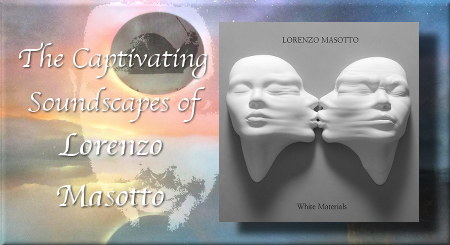
Review - The Captivating Soundscapes of Lorenzo Masotto


"Lorenzo Masotto's journey with music began at the age of nine when he started playing piano. Graduating from Conservatorio di Veona, he consequently started studying composition and jazz. Lorenzo also plays in a prog/post rock band Le Maschere di Ciara, directs a male voice choir, writes music for film and theatre, and teaches piano and composition. 'I've never thought about writing in only one music style,' he says. 'I love all music, and everything I write increases my confidence and ability to write from a wider perspective."

I can tell you right now that this is going to be more of a gushing overview rather than a critiquing review, because I am simply in love with this music. It is flawless and keeps on improving upon what perfection. I consider myself very lucky to have stumbled across the music of Lorenzo Masotto, and I feel compelled to share it with others, as he has released four albums and three EPs that are graceful, emotionally impacting, and shifts in unexpected directions while maintaining absolutely true to itself.

Ironically, even though I often badmouth Soundcloud, it is responsible for my discovery of artists that are now a big part of the soundtrack of my life, such as Suzerain, (iam)warface, and my favorite neoclassical composer, Lorenzo Masotto. On offer were free downloads of "Moon" and "L'impressionista," which I snapped up after giving them a listen. Both songs were essential to playlists of mine that have subsequently become quite expansive, but were just forming when these songs joined them. Therefore, they showed up in my iTunes shuffles quite often. I then realized that this was classical music in a way I had never heard before. It was lyrical without words, soothing without repetition or sleepy ambience, fronted by piano, which I was beginning to love beyond a tool of my training to compose my own songs (Tori Amos also helped quite a bit in this regard).. I had to hear the rest of the album, and I discovered SETA.

This album showcases Lorenzo on the piano with an assortment of guest musicians. It's pretty straightforward in its classical style, and I found myself enthusiastic over an album of this type that I had never been before. So when I discovered that an EP follow-up, Travelers, was released, I dived right in with gleeful abandon, and was not disappointed. It's the perfect epilogue to SETA, offering landscapes described by piano, making their inspirations almost tangible. Without guest musicians, Lorenzo's piano is raw and unencumbered, manifesting unrestricted beauty. I'm not saying that previous guest musicians had limited his compositions, only that alone with his piano, he still manages to evoke an entire orchestra.


Now following this unrivaled composer on Bandcamp, I was notified of the release of a free download of a compilation on which he had contributed a song, called Winter Kept Us Warm, released by Preserved Sound, a label that I continue to keep an eye on. While the album introduced me to multiple artists that I have monitored since, Lorenzo's new song "Chrono" stood out, and has become my favorite song he has released. It is because of this song that I fell completely for Winter Kept Us Warm as a whole. "Chrono" is also the reason I so eagerly anticipated his next release, and when Rule and Case arrived - then available in beautiful hand-made packaging (I believe this was also Preserved Sound's doing) - I practically begged Lorenzo to make it available on Apple Music, through which I was collecting most of my library. Such was not the case, and I was crushed. The following EP, Prime Numbers, almost made up for it. It displayed a fraction of the abstract turn his music was taking, and I could only hope hat his follow-up would be on Apple Music - at the time, my subscription was about all that was in my budget for music.

The pre-release marketing for Aeolian Processes was torturous for me. I didn't think I could handle the disappointment I experienced over Rule and Case again. Lucky for me, it was released on Apple Music, and definitely did not disappoint. Eclectic use of electronics and percussion, with accompanying instruments used in an unusual manner that evokes, but is not, electronic compositions, again with the liberal use of piano; but at times the piano is absent and other instruments, such his stirring strings arrangements, take center stage. This album is all it took to convince me I couldn't live without Rule and Case, and I bought the digital album. One listen of this extraordinary album - one in which I believed true perfection was achieved and even brought me close to tears in unbridled emotion - convinced me that I could never miss out on his music again. I needed to have it all, and I needed to have it now (Rule and Case also contains "Chrono," and nearly every song on the album competes with it for the status as my current favorite). Roughly the same time I took advantage of the free download EP Mountain Paths, which was a return to solo piano, and I voraciously pounced on his discography as listed on his Bandcamp page. I bought the single "Reflector" then and there, but nothing could sate my appetite at that moment. I needed more.

I didn't have to wait too long. When I received an email invitation to hear a preview of his latest album White Materials, I immediately devoted a tab to it as I went about the business of marketing my own music. It was hard to do, as White Materials held my fascination completely. It took everything I loved about Aeolian Processes and Rule and Case to a new level, with the addition of vocals by his wife Stefania Avolio and the return of his sister Laura on the violin. In many ways it is a departure from his familiar styles, and as such he produced it completely by himself, in his home studio. This album rivals Rule and Case as my favorite of his works. Listen to it yourself and be transported into a realm of complete, classical, abstract, and eclectic beauty, in compositions that uniquely defy its categorization at every turn. 


"From the moment my hand touches the piano and I begin to compose, my conscience starts a journey, leaving my body. During its wandering shows me pictures of the places I encounter, creating a sort of connection between my unconscious and my fingers. The colors, the landscapes, the faces of the people it photographs along the way are so clear in my mind to allow to portray those images using the only sound a piano can paint."

- Lorenzo Masotto

Wednesday, November 8, 2017

Starlight Music Chronicles - Second Spotlight!


Today - Wednesday, November 8th, 2017 - hot on the heels of being included in Erosion Factory's 100th Show on Beyond The Dawn Radio, my second interview on Starlight Music Chronicle's Spotlight was published! I'm not ashamed to say that editor Candice Anne Marshal's introduction made me blush. It's support like this that helps me believe my music might be taking me somewhere, like this could turn into a truly successful career. That I have people who listen to, pay for, and care about my music is success enough, but being one degree of separation from artists I admire, have the utmost respect for, and even - in some cases - have on pedestals makes my head spin.

This is nicely timed, as I'm doing a second promotional run for Dialectical Observations, which this interview focuses on. Just over a week ago, I released a new Extended Artist's Edition as a Patreon pledge reward, which you can read about in the previous article. I hope this generates even more interest, and that I might actually be on my way to the next step in my dream, releasing a record on physical mediums. If you'd like to help, just make a pledge at my Patreon. There's a lot of rewards to be had, my appreciation not being the least of them.

I hope this article gives you new insight into my latest album. And I hope my excitement is infectious and washes you in the glow I'm feeling. May your own inner snails remain resilient and determined; even if your dreams aren't fully realized, shit like this can still happen!